Episode Transcript
[00:00:00] Speaker A: Which member left a demanding corporate career and moved to another continent to spend more time with family?
Find out by going to www.bookinterrupted.commembers and get to know us a little more. Parental guidance is recommended because this episode has mature topics and strong language.
Here are some moments you can look forward to during this episode of Book Interrupted.
[00:00:31] Speaker B: We are in the position we're in. We need this help, this development because of something we've done wrong. And what I'm here to say is that it's not your fault. So that's the first line of the first chapter of my book.
[00:00:45] Speaker A: Like the framework that we're living in, our society, patriarchy, whatever you want to call it, it's based on a male's.
[00:00:51] Speaker B: Maybe biology. Yeah, yeah, yeah.
[00:00:54] Speaker A: And I thought that was just so interesting.
[00:00:57] Speaker B: A narrative that on the one hand, tells women you can have it all, but on the other hand has created none of the infrastructure to support you in having it all.
[00:01:08] Speaker A: But at the same time, my children have to leave for school very early and I'm doing yoga at five in the morning. So as soon as you're like, well, maybe I am doing too much too.
[00:01:17] Speaker B: The systems in which we live are based on human beings who do not have a monthly cycle. Which is why I talk about we wax and wane like the moon.
To read a book is the goal.
I want to learn something new.
I don't want to be disrupted.
Mind, body, and soul.
Inspiration is the goal.
And we're gonna talk it out on book.
[00:01:58] Speaker A: On Book Interrupted.
Welcome to the author's spotlight. During these mini episodes, we have authors come on and tell us about their books and why we should read them. Let's listen.
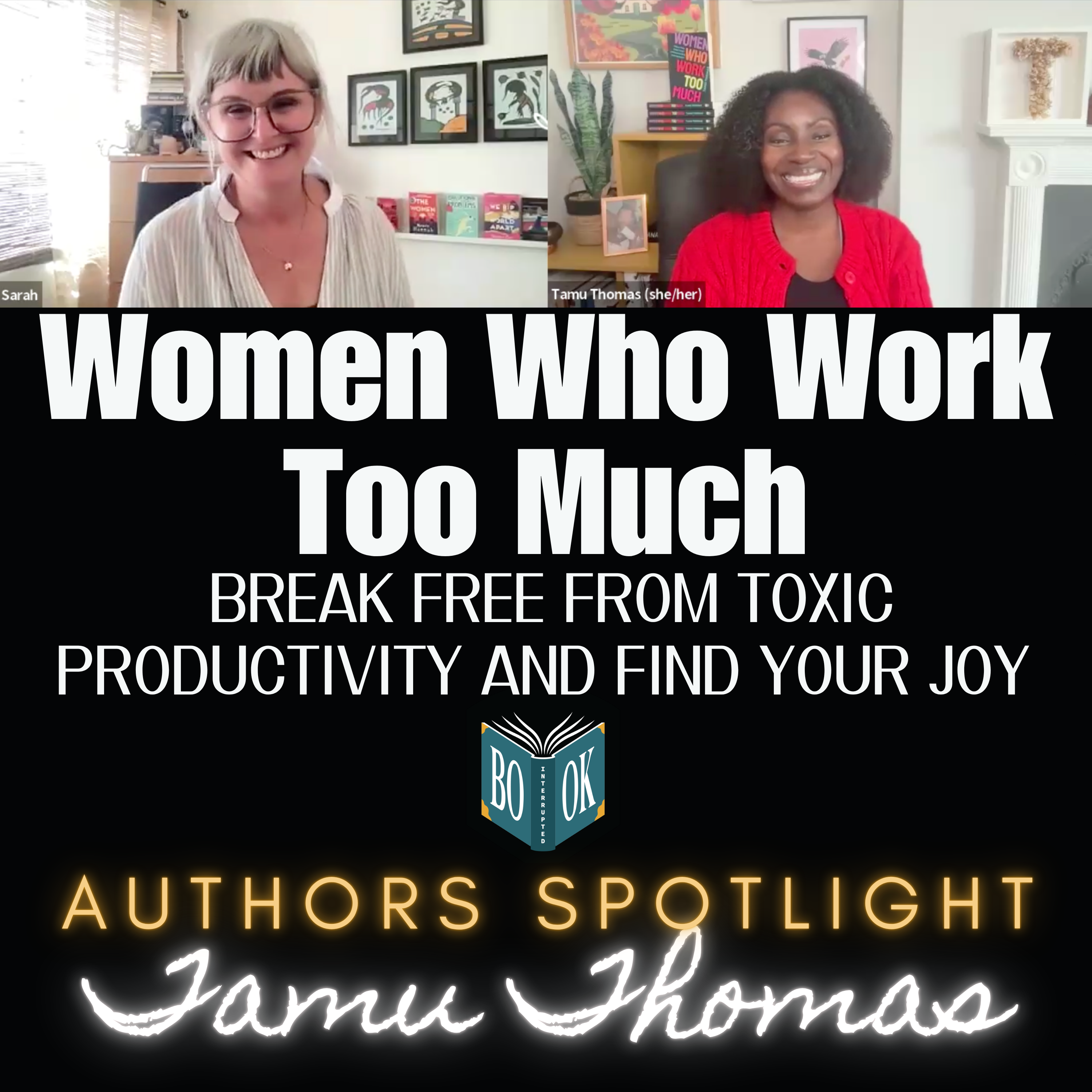
Welcome to the author spotlight. On this episode, we are talking to Tamu Thomas and her book, Women that Work Too Much. Thank you for being on our show.
So why don't you let us know why we should read your book?
[00:02:26] Speaker B: Let me just exhale.
Okay. So the book is called Women who Work Too Much. And it is aimed at women. It's also for everybody.
So the personal development industry and nonfiction books that are about growth and all of that kind of stuff tend to position things in. In a way that infers we are in the position we're in. We need this help, this development because of something we've done wrong. And what I'm here to say is that it's not your fault. So that's the first line of the first chapter of my book.
Women end up in environments where they are over functioning just to survive. And it's not because we've chosen to be that way. It's because the environments in which we live create a narrative that on the one hand tells women you can have it all, but on the other hand has created none of the infrastructure to support you in having it all.
Instead, we were sold the myth of work life balance, which means women are trying to spread themselves thin everywhere in their lives. So if you are a woman who is also a mother, you're trying to be the best mother. You, you probably have a career, so you're trying to be the best employee. You're on the growth track. You want to be a senior leader within your organization, you went to university or you did some kind of qualification to be able to get that role and you don't want to waste it. Then you may or may not have a partner and you want to show up as a conscious partner. You want to make the effort for your relationship because you know it takes work. And the women I'm really speaking to in this book are older millennials and Gen X. So. So we are in our 40s, going into our 50s, so we may also have aging parents that require our support. Then we've got friends we want to maintain relationships with. And then some of us use social media and we want to keep our social media up to date. So we are exhausted. And rather than recognize that we're exhausted, we are googling productivity hacks. We're trying to manage our time better. We want to exercise at 5:30 in the morning so that we have more energy, not realizing that you're just doing too much in the first place and that too much is invariably based on an arbitrary success standard that is not even your own. In women who work too much, I am helping you understand why you behave the way you do. I am helping you understand the impact it has not just on your relationships, but on your relationship with yourself and your relationship with your nervous system. And it is a clarion call for change. I want people, especially women who read this, this book, to recognize their needs as allies, their needs as a bid for connection and burnout. As a love letter from your nervous system saying, sister, you can't carry on like this. We are going to make sure that you hard stop so you can reassess your life and create a standard of success, redefine success so that success and satisfaction are like this together, so you can work out what's important. And you can start to say to yourself, if success means I am left with the dregs of myself, And I am unable to acknowledge all the wonderful things I've done. I don't want it. One of my mottos is our work can be part of our self care. Lots of people like get work away from my self care. But work is one of the primary ways we meet our needs. And for the vast majority of us, work is the longest, most enduring relationship we will ever have. And I say we might as well make it a great relationship. That is why you should buy my book.
[00:06:18] Speaker A: Wow. I love it. So for listeners, I saw an Instagram post of you talking about your book and it blew my mind. I instantly reached out to you because I just think that so many of us just, we are, we're just trapped in this. How do you get out of that? I'm pretty good with balance, but I do the podcast. That's what I do.
But at the same time, my children have to leave for school very early and I'm doing yoga at five in the morning. So as soon as that I'm like, well, maybe I am doing too much too, because at 5 in the morning, before everyone gets up so I can get my yoga in and my meditation, getting up at 5:15.
And I feel like there's a lot of our listeners that are doing exactly the same thing. One of the things in that clip that really drew me in is that you were saying how women are waning and waxing. So it's about women are getting signals from their bodies and our nervous system that's different from like the framework that we're living in. Our society, patriarchy, whatever you want to call it, it's based on a male's, maybe biology.
[00:07:24] Speaker B: Yeah, yeah, yeah.
[00:07:26] Speaker A: And I thought that was just so interesting.
[00:07:29] Speaker B: So just today actually I was in the gym and I, you know, I speak openly about stuff. I'm in my luteal phase and I felt really, really tired and I was going to push through and continue my strength training and I said, no, that's not actually what your body's asking for. Your body wants to move. So I stopped the session and I started walking on the treadmill instead. Me of old would have totally dismissed that because the way our society is structured, we are encouraged to judge ourselves based on who we are during our ovulation phase. Where for people who menstru, that is when we have more energy, we're outward facing, we're much more willing to be sociable and all of those sorts of things. And that is when we're nice, that is when even we look more attractive because estrogen Is doing her thing.
And so everybody is happy when we're that version of ourselves, when it's like, no, don't worry, I can do it. Oh, I've got the energy, I can extend myself. So that then becomes the norm. We judge ourselves by that version of ourselves when that version of ourselves is only available approximately one week a month, 12 weeks in a 12 month year. And I want us to recognize that we don't have to get into patriarchy, this, that, or the other. The systems in which we live are based on human beings who do not have a monthly cycle. Which is why I talk about we wax and wane like the moon. We are expected to behave like we're the moon at full moon time all throughout the month. And that's just not natural. One of the things I talk about in my book is that in the industrial revolution, we created machines to make our lives easier. And then we started judging our humanity against the standard of machines. So then we want to be mechanical rather than cyclical. And as a woman, every human being has the circadian rhythm, which is like our own internal body clock that takes us through morning to night.
Then every human being has autonomic nervous system, and we travel up and down the autonomic nervous system all throughout the day. To simplify it, the bottom of the autonomic nervous system Is when they're like really tired, crashed out, just can't do anything. Then we've got the middle, which is the sympathetic part of the nervous system. In a survival state, it's about fight or flight. But in a healthy state, it gets us up and going. It's where our motivation and ambition comes from. Then at the top of the ladder, we have got the ventral state, which is where we are more joyful. We're very good at connecting with other people. And it's not that we feel so safe and protected from everything. We feel safe and grounded within ourselves to take risks we wouldn't ordinarily take. And that risk may be, I'm very good at connecting. But you say I'm at a networking event, I shrink. I just don't like it. But if I'm in a very ventral state, I'm much more likely to take the risk of initiating a conversation with somebody. So we've got the autonomic ladder that we're traveling up and down all day long. And then as a person that menstruates, we have our different phases of the menstrual cycle.
So our bodies, whether we are conscious of it or not, are constantly working to support our humanity. So that alone is hard work. And that menstrual cycle has a massive impact on. On our autonomic nervous system, and it has a massive impact on our circadian rhythm. So it's not fair to us to judge ourselves based on standards that have been created for people whose testosterone pretty much stays the same throughout the month, and they don't have the ebbs and flows that we experience.
And when we recognize our cyclical nature, rather than judging ourselves by our off days, we can zoom out and see our productivity, our relational skills, and all of those things. We can see that through the arc of a month. And rather than writing ourselves off and telling ourselves we're terrible human beings because we're not particularly productive, on three days of this week, we can zoom out and see, okay, three days of this month, I haven't been very productive, but these are my other patterns. And overall, I am a productive person. So we're able to treat ourselves with a lot more compassion. And the way us human beings are designed, designed when our needs are met and when we're treating ourselves with compassion, because connection is a biological need, and we're the most relational species on this planet. When our needs are met, when we're showing ourselves compassion, it expands our capacity to extend that to other people. And when we extend that to other people, we're much more likely to extend it to our planet as well.
[00:12:16] Speaker A: Amazing.
[00:12:17] Speaker B: I love that.
[00:12:18] Speaker A: It just makes so much sense. And I think it helps us as women, like, reframe, because that's what happens. And you think, I'm not worthy. And then you beat yourself up when you don't have the energy, but then you don't look at. Well, actually, two weeks ago, I was ultimately productive and did way more than.
Yeah, I think that's a great reframe look at your month rather than look at your week, because that's what we do. We look at our week. Oh, was it productive enough this week?
That's amazing.
[00:12:47] Speaker B: And in my book, I break down the menstrual cycle, circadian rhythm, autonomic ladder. There's one chapter called Be a Nervous System's Best Friend, which is going to give you information about your autonomic nervous system and also practical tools so that you can begin to befriend your nervous system at the end of each chapter. Because my book is about toxic productivity. So it's women who work too much, break free from toxic productivity and find your joy. Because ultimately, my work is about women living more joyful lives. So at the End of each chapter there's a joy practice which is informed by somatic science. And throughout the chapters there are different exercises to help you get to know your body, to get to know yourself intimately so that you can start to make powerful choices. We talk about women being empowered and I know it might seem like semantics, but you are powerful. I want women to recognize that they are powerful and they can make powerful choices you in relation to how they live. And that powerful choice may be. I was working with a woman who was almost ruining herself to create a business that generated £10,000amonth. And when we got into the nitty gritty of it, she didn't actually want a business that did that. Her husband made enough money for them to live a good life. She wanted to earn a bit of money so that when she picked up her children from school, if there were friends coming over for play dates and the ice cream van was outside school, she would be able to buy them all ice creams. Because ice creams in the UK ice cream room van are damn expensive. And when they go on holidays, she wanted to have spending money and not have to ask her husband for money. That's what she wanted. She said she would be really content working in the bakery in her little village because she would be able to do a 10 till 2 shift which meant she'd be able to take her children to school and collect them from school. I said, well, why are you doing all of this stuff? I said, you know how many women would jack in their business and do that if they had the supportive environment for that? So she stopped doing the business. She got herself, as she called it, a little part time job that gave her a whole load of freedom to enjoy her life. That's a powerful choice. That is just as powerful as a woman who decides to leave her C suite role to get VC funding to start her own business. A powerful choice is whatever enables you to live life feeling vibrant and energetic.
[00:15:15] Speaker A: Yes, no, I completely agree. That's another reframe. I think that worthy because I made a lot of money. That's not what makes you worthy. Everybody's success looks different. Maybe that someone's success, maybe making tons of money is their success, but maybe someone else's success is working a part time job.
[00:15:33] Speaker B: Exactly, exactly, exactly. Yeah, yeah.
[00:15:37] Speaker A: Okay, well that's actually, you know what, I'm going to ask one more question and then we'll have to wrap up because I'm, I'm, I can't wait to read your book.
So one other thing that I Read is I read a quote that said the positive mindset is the nectar for capitalism.
So I think a lot of us that are like trying to do it all, but also trying to just stay positive. I believe in being optimistic, but I think there's a toxic positivity that's underlines like to just sweep everything under the rug when you're burnt out and overwhelmed. I was wondering if you could elaborate on that point.
[00:16:12] Speaker B: Yeah, absolutely. Because when you are overtly focused on being positive, rather than we conflate blame and taking responsibility, and when we are in this positive mindset, we do not do a very good job of holding people responsible for what they are supposed to provide.
When I think about people who talk about positivity, when I talk about systemic change and social change, they will say, oh, you're just blaming the system. No, I'm not blaming the system. What I am saying is you, government of our country have promised to deliver these things and you haven't delivered these things. So there's no point in me trying to improve myself, trying to have this positive mindset, trying to do all of these things. When I go into the world, I'm met by things that compromise me. So if I think about my experience as black African woman, so you know, I've got the dark skinned black African woman, I can do everything I can do, I can be qualified, I can speak well, I can smile, I can change my demeanor so that it's open and I will still go into spaces where people will judge me based on racial stereotypes. That is because of what is upheld within the system. So what I'm saying is absolutely be optimistic. I'm a very optimistic person and that's partly what led me to burnout. I am a very positive, optimistic, hopeful person. And I also believe that we have a responsibility to each other, to treat each other well. So when we're so focused on being positive, what happens is people don't develop the capacity to have challenging conversations. People assume that a rupture will lead to the dissolution of a relationship. When you have got a positive mindset, you are an optimistic person and you are rooted in hope and care. You can have a challenging discussion to address a rupture and recognize that the repair process can be a portal to bring you and the other party closer. So rather than ignoring elephants in the room, you call them in. You don't necessarily tame them, you acknowledge them. And it means then I can meet you where you are, Sarah, Rather than glossing over things or avoiding you because you're not exactly who I want you to be. I can accept you for who you are and know that there are going to be parts that rub up against me. Maybe I don't agree with, but it doesn't mean that we can't still be in community with each other. And for capitalism, us being divided is great because we're going to keep attacking each other rather than looking at the overall problem. And we're going to keep trying to find mind. I say it's like we tried to have Haribo or little sweets instead of having a proper meal. We're going to keep. Oh, I've got to be positive. So I've got to buy this expensive gym membership. I've got to buy this personal development program. I've got to buy all of these things when really and truly what we need is a community that cares about us and we care for them back.
[00:19:26] Speaker A: Yes. No, I agree. I agree 100. And there's healthy conflict. Also community, a gym membership and doing an online program by yourself.
[00:19:35] Speaker B: Exactly.
[00:19:36] Speaker A: Yeah. Community is so key. And then always glossing things over. I'm a recovering people pleaser, always saying yes to everybody. I say maybe now, maybe so I have time to think.
[00:19:49] Speaker B: Exactly, exactly.
[00:19:51] Speaker A: Right. Yeah. But I think that that's because you're trying to be always positive and happy and it gets you into the point where you end up getting burnt out. Keeps you in a system because you're just too tired to be like, I can't fight anything else. Like, it's trying to be positive. And I think there really is a toxic positivity that not that many people talk about. They just keep on trying because they
[00:20:15] Speaker B: don't want to be seen as negative. And it's not negative. It's actually being truthful, honest.
[00:20:20] Speaker A: Yeah, completely true. I think your book is exceptional. I can't wait to read it.
[00:20:24] Speaker B: Thank you.
[00:20:25] Speaker A: I think there's just so many of us, like everywhere that are just.
So many of them are just burnt out. I remember I. I had a real burnout situation where I had a miscarriage because I was working too much and I didn't take it off because we had a big trade show. So I was working like two and a half weeks straight and someone gave
[00:20:42] Speaker B: me a Tony Robbins book.
[00:20:43] Speaker A: They're like, do this.
And I realized, like, one of the things I thought I needed to do for my family to be healthy, I had to make everything from scratch. I had to. I worked in the corporate world.
I had toddlers, two small children, and I was pregnant and I was making everything from Scratch. And working crazy hours. I'm like, what? What? And ballet and soccer and I hear you.
[00:21:05] Speaker B: Completely, Completely.
[00:21:08] Speaker A: Why?
[00:21:08] Speaker B: It's ridiculous.
[00:21:10] Speaker A: It's just ridiculous. Why?
[00:21:12] Speaker B: Yeah, it'd be fine if that's all you did all day long, but it's unsustainable, right?
[00:21:18] Speaker A: And you're like, oh, trying to be healthy and I'm doing my meditations before I fall asleep.
[00:21:23] Speaker B: It's just like.
[00:21:23] Speaker A: And, yeah, time with your husband. And you're like, ex.
[00:21:26] Speaker B: When does it end? When does it end?
I even know people who are like, optimizing their sleep and they're listening to whatever it is through the night and I'm just like, give your brain a break enough.
Exactly.
[00:21:40] Speaker A: Yeah, I know.
[00:21:41] Speaker B: Yeah. Yeah.
[00:21:42] Speaker A: Thank you for coming on my show.
[00:21:43] Speaker B: I wish you could stay longer.
[00:21:45] Speaker A: Listeners. You can pick up women who work too much on the Book Interrupted website and it's www.bookinterrupted.com shop and it'll be under Author Spotlight. You can click there and it'll take you to Amazon and you can pick up Tamu's book. Thanks so much for being on the show. I really enjoyed it and I can't wait to read your book.
[00:22:05] Speaker B: Awesome. Thank you for having me.
[00:22:07] Speaker A: Thank you for joining us on this episode of Book Interrupted. If you'd like to see the video highlights from this episode, please go to our YouTube channel, book interrupted. You can also find our videos on www.bookinterrupted.com.
[00:22:22] Speaker B: thank you so much, so much for
[00:22:24] Speaker A: listening and supporting us. Do you know you can also support us by wearing some of our kick ass swag. Check it out at www.bookinterrupted.com shop.
[00:22:36] Speaker B: Book interrupted.
Never forget, every child matters.
[00:22:43] Speaker A: Hey, this is Sarah. If you've been listening to Book Interrupted for a while, then you know that our conversations are less about books and more about what's said between the pages. We've let the stories shape us and if you've been with us since the very beginning, you'll remember our first season and our very first book, Women who Run with the Wolves by Clarissa Pinkola Estes. That book cracked something open in me. The conversations we started there never really ended. It just kept growing, kept whispering, kept calling. Book Interrupted was inspired by it. Well, that whisper has now become a how. I'm launching a new podcast called the Wild Women with Sarah Diop. And it was born directly from that first season, that first book, that very first conversation on Book Interrupted when we started to talk about reclaiming our wild and rewilding and becoming our authentic selves.
This show will be a space for women to feel the pull to write their own story, to look at their coulds instead of all their shoulds. It's a remembering coming back to your true, authentic self.
Now, on our last episode, I mentioned the book I wrote, which is Awaken your Wild Woman Workbook, and this is kind of extension of that book and those feelings. Each month we'll explore what it means to live an untamed life and not shrink or dim your light. We'll follow the cycles of the moon, the wisdom of the seasons, and I'll shine a spotlight on the wild women that inspire me, which are authors, healers, astrologers, writers, creators.
So have you ever felt that whisper in your own wild woman? The one who knows her truth refuses to be quiet, who's ready to come home to herself?
This new podcast is for you, so search the Wild Woman with Sarah Diop wherever you listen to your podcast, then hit the subscribe button so you don't miss any of the episodes. I can't wait to meet you there.
Thank you for all the support and I'll see you soon.